
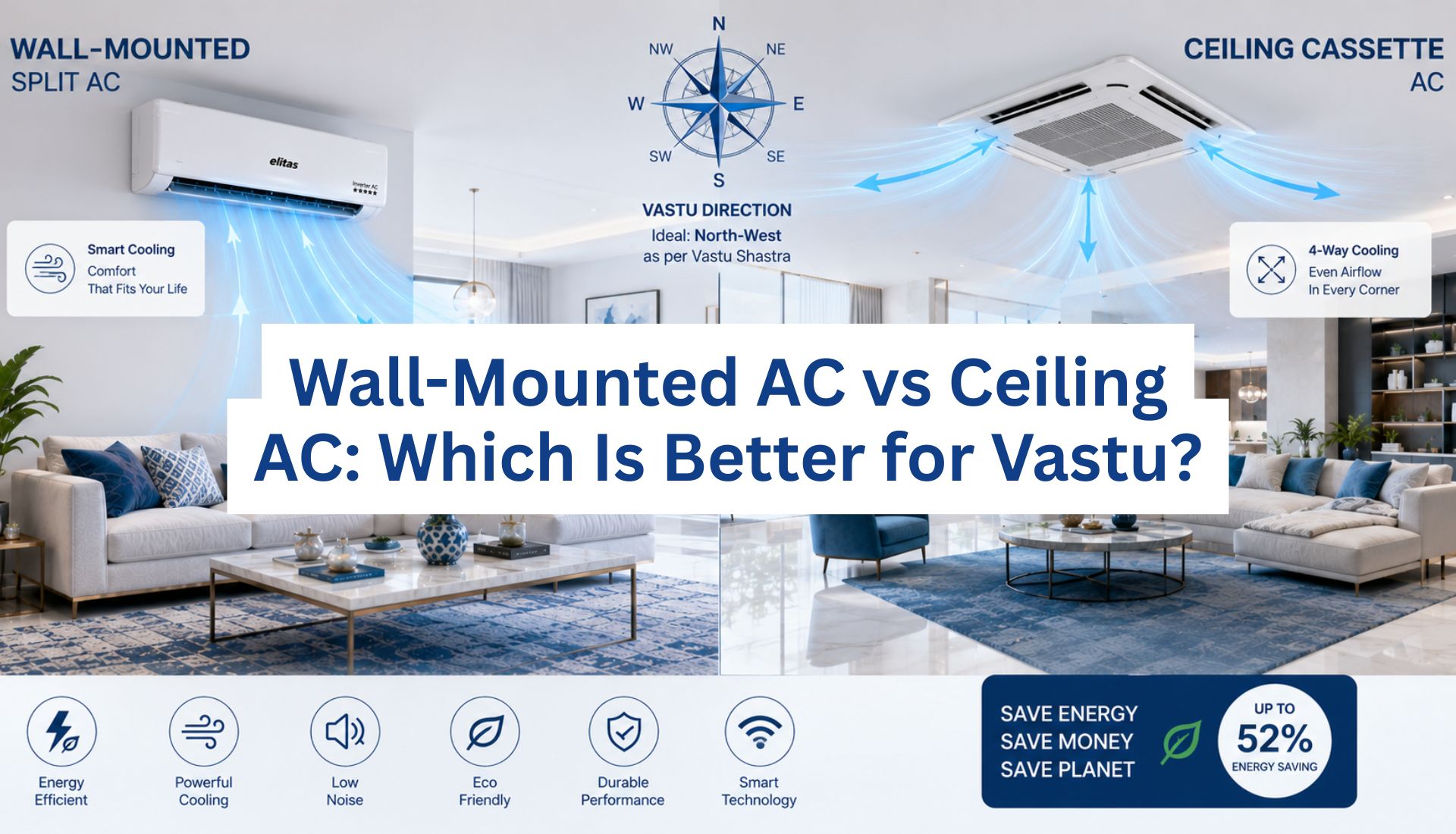
 Choosing the right air conditioner is about more than selecting the correct capacity or energy rating. The type of air conditioner you install can affect cooling performance, room aesthetics, installation costs, maintenance, and how well it fits your home’s layout.
Many Indian homeowners also consider Vastu Shastra when selecting and installing air conditioners. While Vastu recommendations are based on traditional beliefs rather than scientific evidence, they remain an important part of home planning for many families.
This guide compares wall-mounted split air conditioners and ceiling cassette air conditioners from practical, energy-efficiency, and Vastu-conscious perspectives to help you make an informed decision.
At Elitas Appliances, we offer advanced cooling solutions, including our Vastu Series Air Conditioners, designed for homeowners seeking efficient cooling and thoughtful installation options.
Understanding the Two Types of Air Conditioners
What Is a Wall-Mounted Split AC?
A wall-mounted split AC is the most common type of air conditioner used in Indian homes. It consists of an indoor unit mounted on a wall and an outdoor condenser unit connected through refrigerant pipes.
Wall-mounted ACs are popular because they:
- Are suitable for most bedrooms and living rooms.
- Require relatively simple installation.
- Offer energy-efficient inverter technology on many models.
- Are easy to maintain and service.
- Come in a wide range of capacities and features.
What Is a Ceiling Cassette AC?
A ceiling cassette AC is installed within a false ceiling, with only the decorative grille visible. These systems typically distribute cooled air in multiple directions, making them suitable for larger open spaces.
Ceiling cassette ACs are commonly used in:
- Large living rooms.
- Open-plan homes.
- Offices.
- Retail stores.
- Conference rooms.
- Commercial spaces.
They generally require a suspended or false ceiling and professional installation.
Cooling Performance Comparison
Wall-Mounted AC
Wall-mounted split ACs deliver cool air from one direction. Modern units often include automatic swing functions that improve air distribution throughout the room.
They work particularly well in:
- Bedrooms.
- Small and medium-sized living rooms.
- Study rooms.
- Apartments.
Ceiling Cassette AC
Ceiling cassette units usually provide four-way airflow, helping cool large rooms more evenly. This makes them a good option for spacious areas with multiple seating zones.
However, achieving efficient cooling also depends on factors such as room insulation, ceiling height, and selecting the correct AC capacity.
Energy Efficiency
Both wall-mounted and ceiling cassette air conditioners can be energy efficient when properly sized, professionally installed, and maintained.
Electricity consumption depends on several factors, including:
- Energy rating.
- Inverter technology.
- Room size.
- Insulation.
- Outdoor temperature.
- Usage habits.
- Maintenance.
Choosing an appropriately sized inverter model and following the manufacturer’s recommendations are more important than the type of indoor unit alone.
Installation Requirements
Wall-Mounted Split AC
Wall-mounted systems are generally easier and quicker to install. They do not require a false ceiling and are suitable for most homes.
Advantages include:
- Lower installation complexity.
- Easy servicing.
- Simple access for maintenance.
- Flexible wall placement.
Ceiling Cassette AC
Ceiling cassette units require additional planning because they are installed within a false ceiling.
Considerations include:
- Sufficient ceiling space.
- Professional installation.
- Proper drainage.
- Adequate maintenance access.
- Structural suitability.
Vastu Considerations
According to traditional Vastu Shastra, electrical appliances are commonly associated with the South-East direction. The North-West is another direction many homeowners consider for air conditioners.
Whether you choose a wall-mounted AC or a ceiling cassette AC, practical factors such as safe installation, unobstructed airflow, and the manufacturer’s instructions should always take priority.
Many homeowners successfully combine Vastu-conscious planning with professional HVAC installation to achieve both comfort and efficient cooling.
Which Option Is Better for Homes?
For most Indian homes, wall-mounted split air conditioners are often the preferred choice because they are easy to install, maintain, and suitable for typical room sizes.
Ceiling cassette ACs are generally more appropriate for larger homes, villas, luxury residences, and open-plan spaces where wider air distribution is beneficial.
Wall-Mounted AC vs Ceiling AC: Quick Comparison
| Feature | Wall-Mounted Split AC | Ceiling Cassette AC |
|---|---|---|
| Best For | Bedrooms, living rooms, apartments, small offices | Large halls, villas, offices, retail stores, commercial spaces |
| Installation | Simple wall installation | Requires a false ceiling and professional installation |
| Air Distribution | Single direction with swing mode | Four-way airflow for wider coverage |
| Maintenance | Easy access for cleaning and servicing | Requires ceiling access for maintenance |
| Initial Installation Cost | Generally lower | Generally higher due to ceiling work |
| Appearance | Visible indoor unit | Minimal visible design with only the grille exposed |
| Suitable Room Size | Small to medium rooms | Large open spaces |
| Common Residential Use | Very common | Less common, mainly in premium homes |
Advantages of a Wall-Mounted Split AC
Wall-mounted split air conditioners remain the preferred choice for most Indian households because they combine affordability, convenience, and reliable cooling performance.
- Easy to install in most homes.
- Lower installation costs.
- Wide variety of capacities and models.
- Available with inverter technology and smart features.
- Simple filter cleaning and servicing.
- Suitable for bedrooms, living rooms, and study rooms.
- Excellent energy efficiency in modern inverter models.
Advantages of a Ceiling Cassette AC
Ceiling cassette air conditioners are designed for larger spaces where uniform cooling is a priority.
- Four-way airflow for even cooling.
- Clean and elegant appearance.
- Ideal for open layouts.
- Reduced visibility of the indoor unit.
- Suitable for luxury homes and commercial environments.
- Effective cooling across wider areas.
Things to Consider Before Choosing
Before selecting an air conditioner, evaluate these important factors:
- Room size and ceiling height.
- Availability of a false ceiling.
- Cooling requirements.
- Budget for installation and maintenance.
- Energy efficiency rating.
- Accessibility for future servicing.
- Noise level preferences.
- Home interior design.
- Traditional Vastu preferences, if applicable.
Maintenance Comparison
Regular maintenance is essential for both wall-mounted and ceiling cassette air conditioners.
Wall-Mounted AC
- Easy filter removal.
- Convenient servicing.
- Lower maintenance complexity.
- Simple inspection of the indoor unit.
Ceiling Cassette AC
- Maintenance may require ceiling access.
- Professional servicing is recommended.
- Drainage systems require regular inspection.
- Filter cleaning may take longer than wall-mounted units.
Which AC Is Better for Different Rooms?
Bedroom
A wall-mounted split AC is generally the best choice due to its efficient cooling, quiet operation, and ease of installation.
Living Room
For most living rooms, a wall-mounted inverter AC provides excellent performance. Ceiling cassette ACs can be considered for very large or open-plan living spaces.
Open Hall
Large open halls benefit from the wider airflow provided by ceiling cassette systems, particularly where there are multiple seating areas.
Office
Small offices often use wall-mounted split ACs, while larger office spaces commonly use ceiling cassette systems for more uniform cooling.
Why Choose the Elitas Vastu Series Air Conditioner?
At Elitas Appliances, we understand that every home has unique cooling needs. Our Elitas Vastu Series Air Conditioners combine modern cooling technology with installation options that support Vastu-conscious home planning.
Key benefits include:
- Energy-efficient inverter technology.
- Reliable cooling for Indian weather conditions.
- Modern and elegant indoor unit design.
- Suitable for Vastu-conscious installation planning.
- Quiet operation and dependable performance.
- Designed for long-lasting comfort.
Explore our complete range of air conditioners:
https://elitasappliances.com/air-conditioners
Learn more about the Elitas Vastu Series:
Conclusion
Both wall-mounted split ACs and ceiling cassette ACs offer effective cooling when properly selected and professionally installed. The best option depends on your room size, ceiling design, budget, and cooling requirements.
For most Indian homes, wall-mounted split ACs remain the practical choice because they are easy to install, energy efficient, and simple to maintain. Ceiling cassette ACs are better suited for large homes, villas, offices, and commercial spaces where even air distribution is essential.
If you also consider Vastu while planning your home, traditional recommendations can be incorporated alongside professional HVAC design and manufacturer installation guidelines. Since Vastu principles are based on traditional beliefs rather than scientific evidence, they should complement—not replace—good engineering practices.
Upgrade Your Home Cooling with Elitas Appliances
Visit Elitas Appliances to explore our premium range of air conditioners. Discover how the Elitas Vastu Series Air Conditioner combines energy-efficient technology, stylish design, and Vastu-conscious installation options to deliver lasting comfort for modern Indian homes.
Frequently Asked Questions
1. Which is better for homes: a wall-mounted AC or a ceiling AC?
For most homes, a wall-mounted split AC is the better choice because it is easier to install, costs less, is simple to maintain, and provides efficient cooling for bedrooms and living rooms. Ceiling cassette ACs are generally better suited for large open spaces or commercial environments.
2. Is a ceiling cassette AC more powerful than a wall-mounted AC?
Not necessarily. Cooling performance depends on factors such as the AC’s capacity (tonnage), inverter technology, room size, insulation, and installation quality. Ceiling cassette ACs mainly offer wider air distribution rather than inherently greater cooling power.
3. Which AC type is recommended according to Vastu?
Traditional Vastu Shastra does not specifically recommend one AC type over another. It focuses more on proper placement and airflow. Many homeowners choose wall-mounted split ACs because they are easier to position according to commonly followed Vastu directions such as the South-East or North-West.
4. Does a ceiling AC consume more electricity?
Electricity consumption depends on the AC’s energy rating, inverter technology, capacity, and usage habits rather than whether it is wall-mounted or ceiling-mounted.
5. Is a wall-mounted split AC easier to maintain?
Yes. Wall-mounted split ACs generally provide easier access for cleaning filters, servicing, and repairs compared to ceiling cassette systems.
6. Which AC is better for large living rooms?
Large living rooms or open-plan spaces may benefit from a ceiling cassette AC because of its four-way airflow. However, a properly sized wall-mounted inverter AC can also provide effective cooling in many residential settings.
7. Can I install a ceiling cassette AC without a false ceiling?
In most cases, no. Ceiling cassette ACs are designed to be installed within a false ceiling that provides space for the indoor unit, drainage, and piping.
8. What is the best temperature setting for energy efficiency?
A setting between 24°C and 26°C is generally recommended to balance comfort and reduce electricity consumption.
9. Are inverter wall-mounted ACs energy efficient?
Yes. Inverter wall-mounted ACs adjust compressor speed according to cooling demand, helping maintain a consistent temperature while using electricity more efficiently than many non-inverter models.
10. Why choose the Elitas Vastu Series Air Conditioner?
The Elitas Vastu Series Air Conditioner combines advanced inverter technology, reliable cooling, modern design, and installation options that support Vastu-conscious home planning while meeting the cooling needs of Indian households.